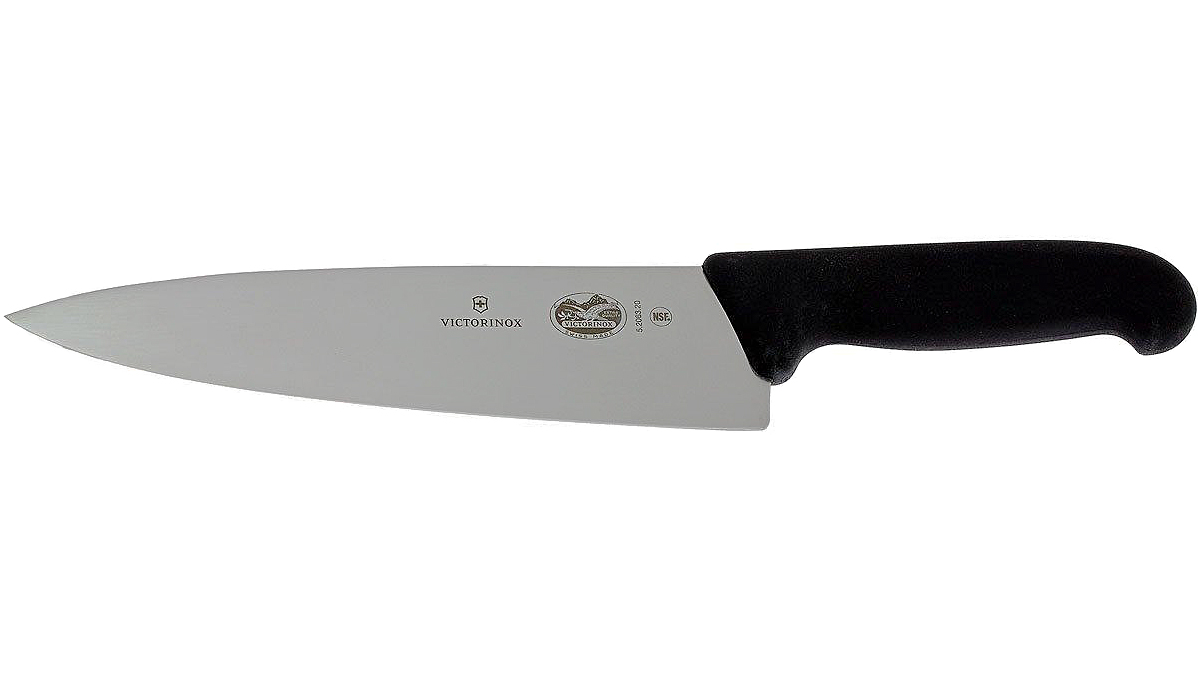
A dull knife does not slice a tomato. It presses down until the skin dents and the flesh bursts sideways. That is the state most kitchen knives reach within a year of purchase. It is also the moment they get pushed to the back of a drawer and left there.
The Victorinox Fibrox 20 cm is the knife professional kitchens reach for instead. The blade is stamped from a single sheet of Swiss stainless steel and ground thin. It sits in a moulded Fibrox handle that keeps its grip when wet. Culinary schools issue it to first-year students because it survives abuse and holds an edge. The steel is soft enough to sharpen on a cheap stone in two minutes. It is hard enough to keep that edge through a week of cooking. Sharpen it when it slows. It cuts the same way in year twenty as it did on day one.
It costs 37,00 euro. A stainless chef's knife from HEMA costs 6,39 euro. On paper the cheap one looks like the smarter buy. The problem is the edge. A budget blade is stamped from softer steel, sold barely sharp, and almost never resharpened by the person who owns it. It dulls within months. It goes in the bin inside a year or two and gets replaced by the next one just like it. Ten years of that is a small pile of dead knives and the same job done badly the whole way through.
Here is the arithmetic over a decade.
| Victorinox Fibrox 20 cm | HEMA stainless knife | |
|---|---|---|
| Price | 37,00 euro | 6,39 euro |
| Lifespan | decades, resharpened | one to two years |
| Bought in 10 years | one | five to eight |
| Cost over 10 years | 37,00 euro | 32 to 51 euro |
The Fibrox draws level on cash inside a decade. Past that it pulls ahead every year, still cutting while the cheap knives keep coming. It wins harder on the work itself. A knife you sharpen is a knife you reach for. A knife you reach for is one you keep.
Verdict: the cheapest chef's knife a professional kitchen trusts, and the last one most homes need to buy.