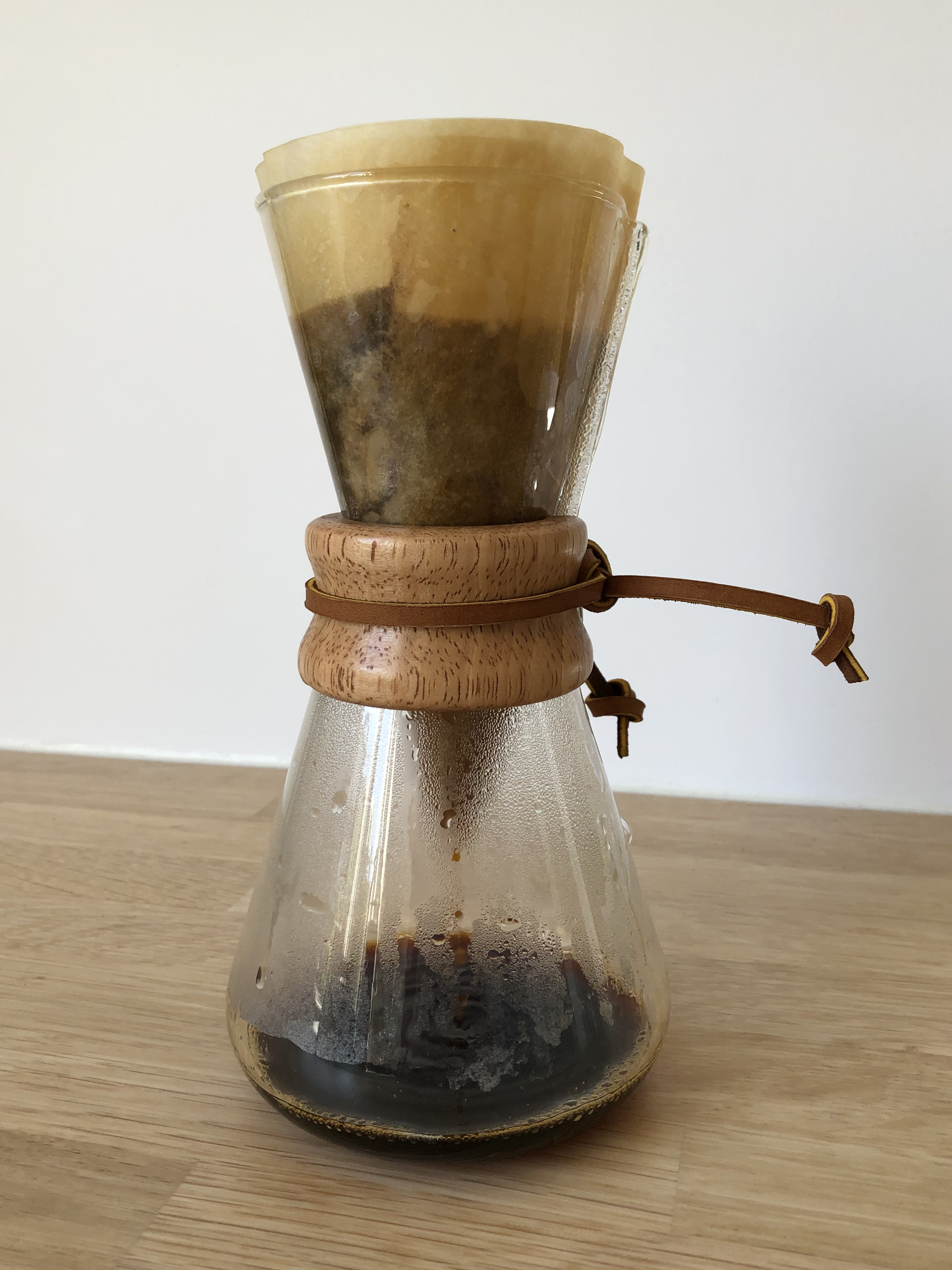
The glass has an hourglass waist and a wooden collar tied at the neck with a leather cord. That is the whole machine. There is no heating plate, no pump, no circuit board, no reservoir that furs up with limescale. Peter Schlumbohm, a chemist, drew it in 1941 from a lab funnel and an Erlenmeyer flask. The design has not changed since, and a Chemex sits in the permanent collection of the Museum of Modern Art in New York.
What lasts here is what was left out. A single piece of borosilicate glass has nothing to wear out. It goes through the dishwasher and a paper filter drops straight into the neck. The only parts that ever need replacing are the leather tie on the wooden collar and the paper filters, both cheap and both sold loose. A body bought today will outlive the person who buys it.
Now the money. A 6-cup Classic costs 53,95 euro. The filter machine on the shelf below it at Action costs 15 euro, and it brews well enough until the element scales up or the switch dies. Budget machines like that tend to give out within a few years, and then you carry the whole plastic assembly to the bin and buy another. The Chemex has no assembly to fail. Over fifteen years the cheap machine is bought four or five times over, and every one of those ends as landfill.
| Chemex 6-cup | Cheap drip machine | |
|---|---|---|
| Price | 53,95 euro | 15 euro |
| Expected life | Decades | A few years |
| What fails | Nothing electronic | Element, switch, pump |
| Cost over 15 years | 53,95 euro | 60 to 75 euro |
The arithmetic is quiet and it is real. The expensive object turns out to be the cheaper one before the decade is out, and it pours a better cup the entire time. It also looks like something you would leave on the counter rather than hide in a cupboard, which is its own kind of return.
Verdict: buy the glass once and let the plastic machines keep breaking for everyone else.